We Ran a Business LARP. People Went Deep.
In Malmö, on a cold March day, twenty-four participants spent a day investigating six fictional organisations that had tried — and mostly struggled — to embed futures thinking holistically into how they planned and operated. That was the premise of Building Future-Ready Organisations, a workshop developed by Changeist at the invitation of Skåne-based Media Evolution.
It was not a lecture about futures methods. It was not a strategy session. It was something closer to a forensic case investigation. Participants arrived to find out they were serving as independent panel members convened to review six fictional regional organisations, looking back seven years from 2035 to today. These organisations had been tasked with building futures capacity with the support of an equally fictional regional bureau. Some of what they attempted had taken hold. Much of it hadn't. The panel's job was to find out why.
Why dissect before building? There's a recurring problem in futures education: you're trying to teach people to do something many of them have never done and might never be reosurced to do at full scale — largely because of institutional constraints and/or cultural challenges. Building a flourishing and persistent future culture inside an organisation is challenging enough that fewer have actually managed it than embarked on it. The conventional response is to ask people to imagine forward — to speculate, to prototype, to scenario-plan their way into possibility. This workshop went the other direction. Rather than ask participants to construct a futures ecosystem, we gave them one that had already been tried — and asked them to analyse the successes and challenges or failures.
Before the day
The workshop was preceded by a lecture at Media Evolution the previous morning — an introduction to the Future Cultures framework and the structural challenges of building anticipatory capacity inside real organisations. Not everyone who attended the workshop had been at the lecture, but there was enough overlap that real-world examples and reference points were already in the air when participants sat down.
Designing for recognition
The six fictional organisations — a municipality, a regional authority, a cultural institution, a manufacturing company, an NGO, and an innovation intermediary — were not invented from whole cloth. Each was researched and built to mirror the Skåne ecosystem: close enough to real organisations that participants would recognise the culture, the pressures, the language, and the failure modes. The fictional frame made it safe to be precise. No one was defending their own workplace or protecting a colleague from criticism. Doppelgängers, in some cases. Composites in others.
This is a deliberate design approach we’ve written about before — the value of familiar forms in unfamiliar circumstances. Calibrating where to land in the space between now and the future you’re transporting your audience into takes careful consideration. Land too far from the familiar and people spend their energy on managing estrangement rather than insight. Land too close and the fiction dissolves into the contestable present. The goal is the productive middle: plausible enough to investigate seriously, fictional enough to evaluate honestly.
The documents in each participant’s packet — internal memos, board minutes, staff surveys, exit interviews, strategy documents, email chains — were written in the same register. They read like real institutional documents because they were designed that way. The futures work wasn’t in the form. It was in the details.
"The fictional frame made it safe to be precise. No one was defending their own workplace or protecting a colleague from criticism."
The morning was Archivist mode: what happened, and why? The afternoon was Futurist mode: given what you found, with the addition of five drivers shaping the current landscape, what does this organisation need to do next?
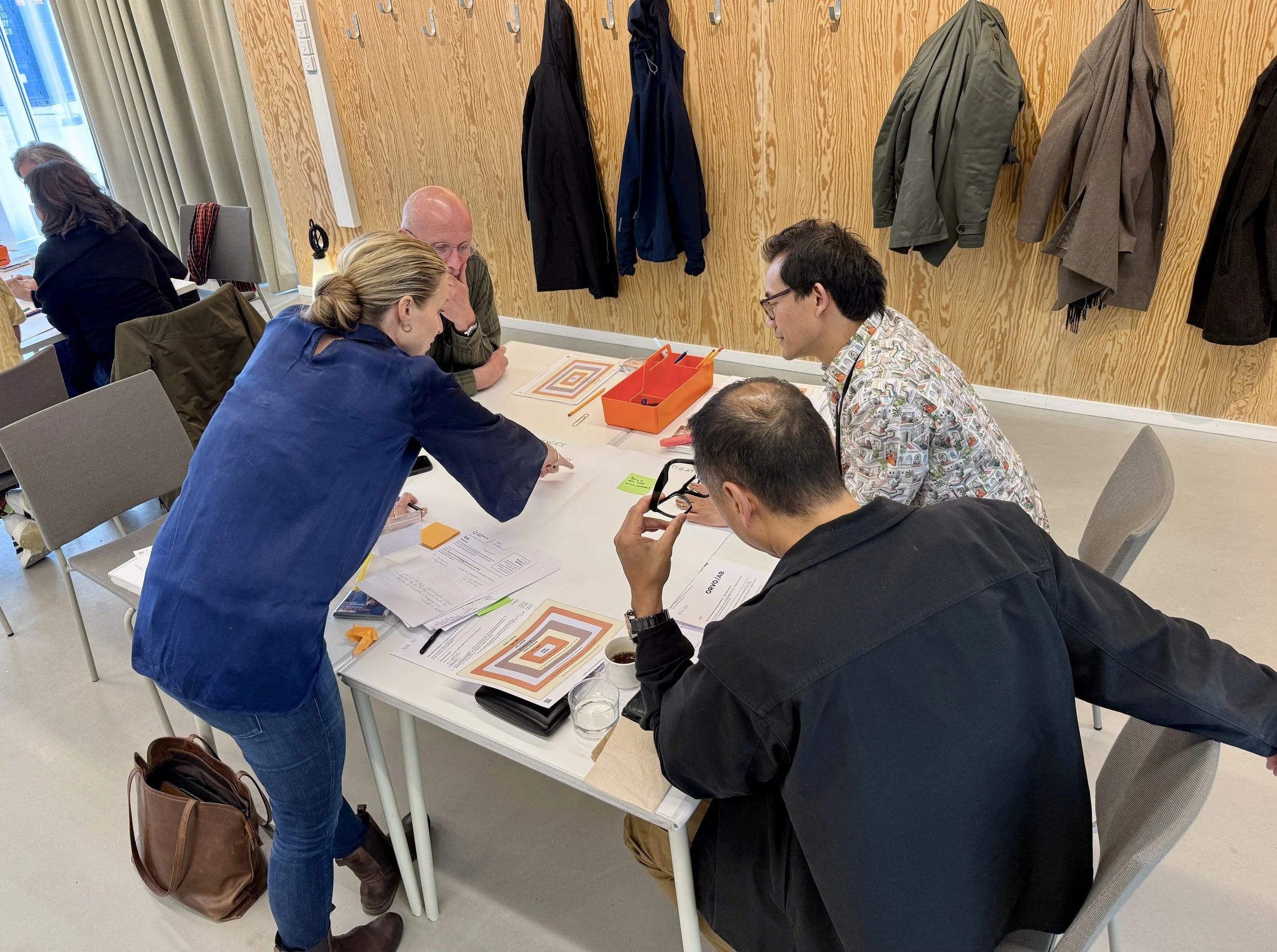
Teams retrace the timelines, and compare notes.
Inside the investigation
Each participant was assigned to one organisation with a specific analytical lens from the Future Cultures framework — People & Mindset, Language & Communication, Tools & Knowledge, Space & Experience, Rules & Norms, or Networks & Ecosystems — with which they would assess their documents packet. They read, they discussed, then built their theories.
What we didn't fully anticipate — and what made the day — was how deep participants went. Tables reconstructed timelines, tracked decisions across documents, identified recurring characters. One table noticed a particular surname appearing in the notes of multiple documents and, noting the common dynamic in the region, observed: "That's power converging." That's not a workshop response. That's an investigation — and the kind of observation only possible when participants know the landscape they're reading.
Teams noticed contradictions between what organisations said publicly and what the internal records showed — the strategy that named all the right things, the survey that told a different story three years later. This is what the investigative format makes possible: taking a culture apart carefully enough to see where the weak points hide and where something that looked like failure was actually a quiet success that nobody had thought to measure. One participant described it as decoding a police procedural. In Malmö, that felt entirely appropriate.
What the documents showed
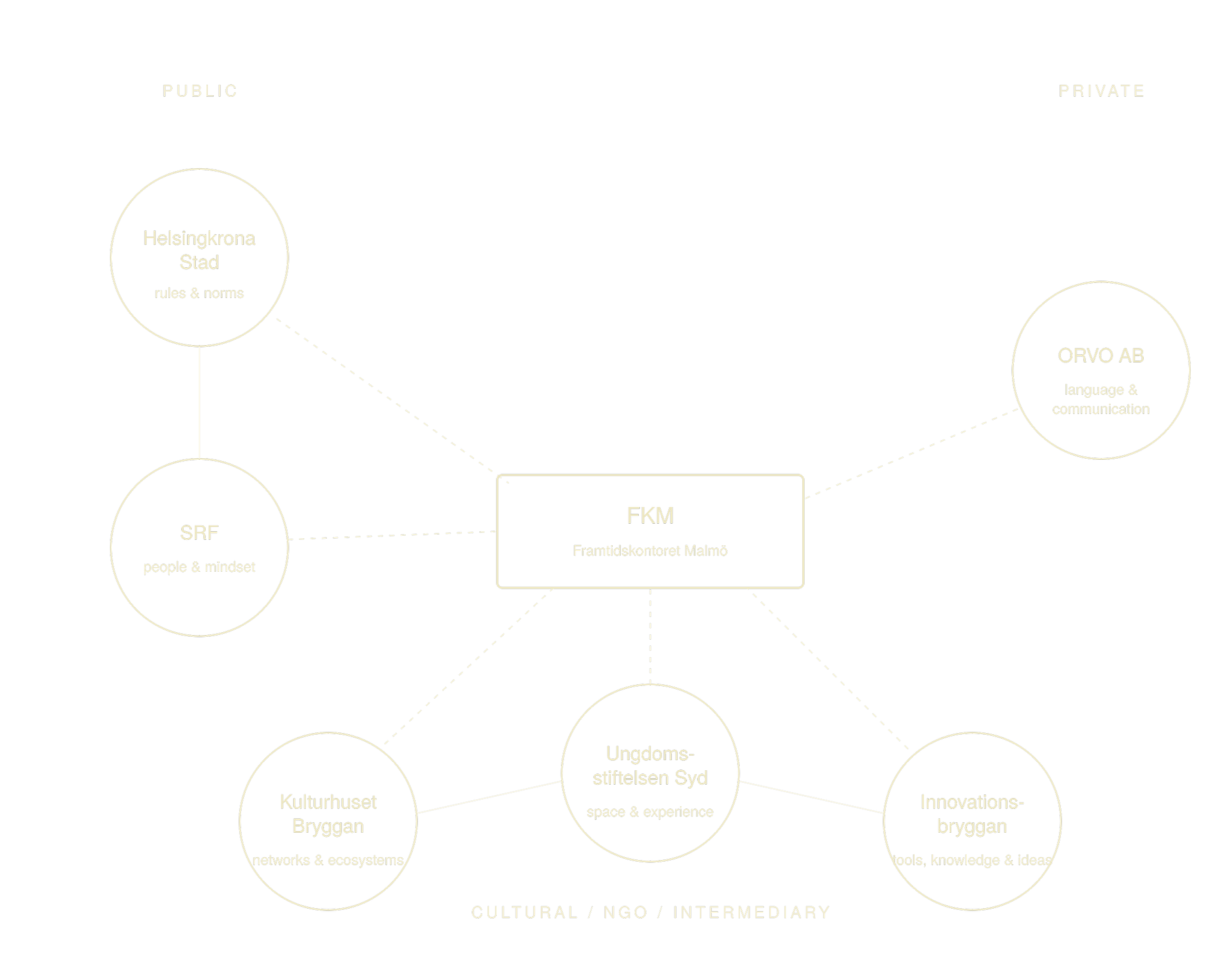
It’s worth saying something here about FKM, or Framtidskontoret Malmö, the fictional regional futures bureau at the centre of the scenario. FKM is invented, but what it represents isn’t: an under-resourced foresight function charged with making futures work useful across an organisation or ecosystem, while lacking sufficient authority, budget, or sustained attention from leadership to do so.
FKM was attempting to hold six very different organisations together around a shared practice. The participants were evaluating if each organisation had built futures capacity as well, as if the connective tissue between them — the thing FKM was supposed to provide — had held. In most cases, it hadn’t. That outcome is familiar to anyone who has worked inside or alongside an internal foresight team.
The patterns that emerged across the six organisations were uncomfortable in the best way — not because the fictional organisations had made obvious mistakes, but because the missteps were recognisable. The same dynamics appeared again and again, in different registers, across different sectors.
Participants recognised that in some cases futures and foresight skills lived in individuals, not institutions, and then disappeared when those individuals moved on. Capability built through training programmes had nowhere to land once training ended. Foresight functions produced good intelligence which went unused, because the decision-making infrastructure needed both probability and confirmation of accuracy, both of which aren’t common or useful artifacts of deep organisational foresight work. Strategies that named the right things to question or reframe were never changed. Successful pilots never became embedded practice.
Several patterns cut across all six organisations, and pointed toward something structural rather than cultural: the consistent mismatch between the time horizons futures work requires and the planning cycles organisations actually run on; the gap between what is measurable and what is valuable; the difficulty of moving from transactional relationships with futures practice to genuinely co-productive ones.
One pattern became distinct just looking at the collective map we built: stress points clustered toward the inside of the organisations. External relationships and networks showed mixed results. The deeper in — toward how an organisation governs itself, allocates time, makes decisions, cultivated skills — the more consistently things hadn’t held.
The group named one reason why. Space & Experience — the physical and cultural conditions that make futures thinking possible in the first place — is a moat. You can train people, build tools, write strategies but if there’s no time, no permission and no protected space — real or virtual — to actually think, little survives contact with the organisation’s existing machinery.
The inner layers of the framework, where futures work has to become habit and practice rather than project and event, were exactly where the map showed the heaviest concentration of failure. The two observations sit together: cross the Space & Experience threshold and the deeper work becomes possible. Fail to cross it and nothing else sticks.
"Space & Experience is a moat. You can train people, build tools, write strategies — but if there's no time, no permission and no protected space to actually think, little survives contact with the organisation's existing machinery."
Why fiction works better than fact
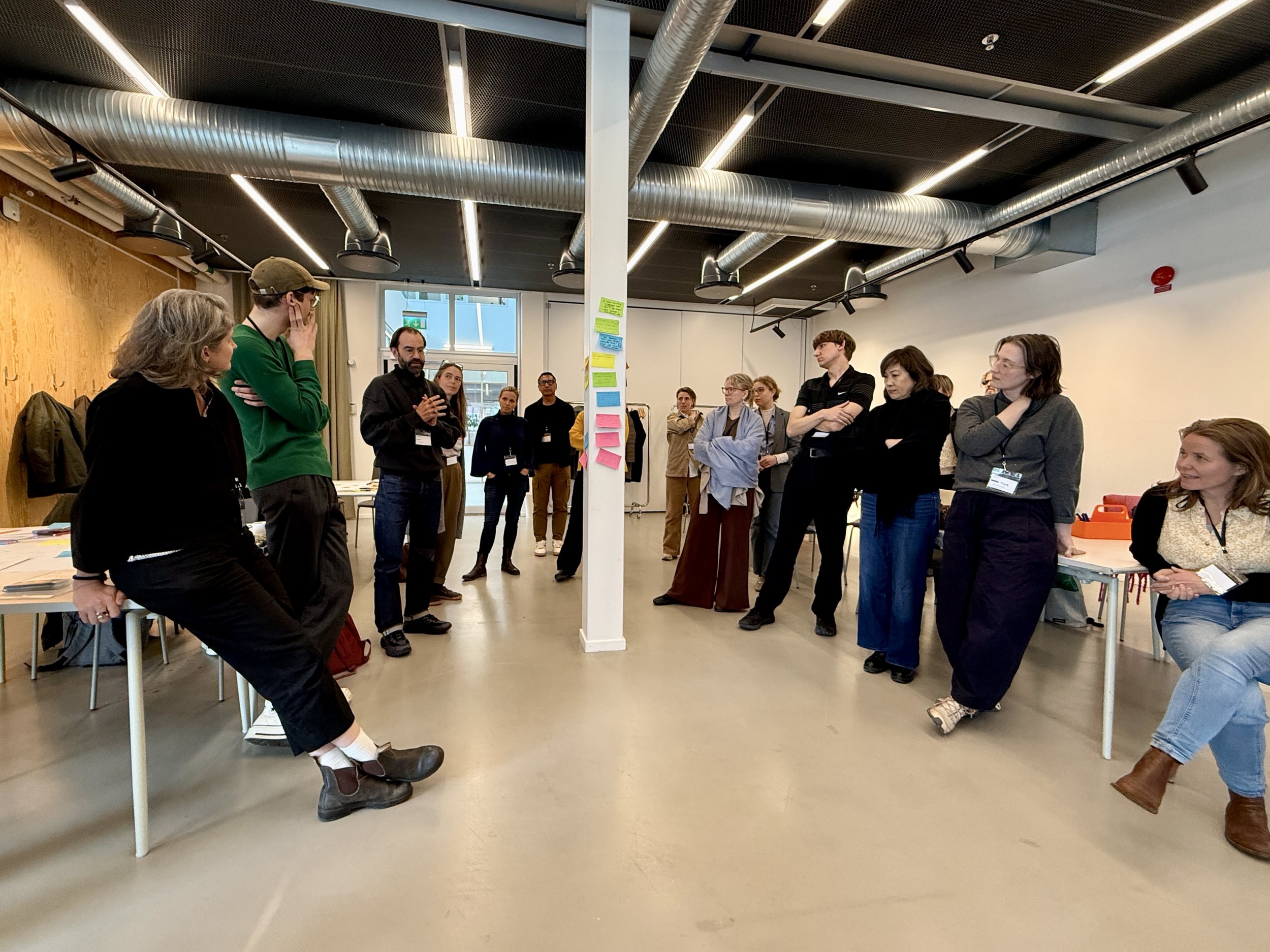
The fictional frame did something that direct conversation about organisational change rarely does: it gave people permission to be precise. When the failing organisation is not yours, you can say clearly what went wrong and why. When the evidence is in front of you rather than in your head, the conversation is grounded. When the characters are invented, no one has to protect anyone, even themselves.
And yet the distance collapsed, consistently, over the course of the day. By the afternoon, participants were drawing direct lines between what they’d found in the scenario and what they recognised in their own organisations. The forward design phase — What should this organisation do next? — produced recommendations that were less about the fictional organisations and more about the real ones those sitting around each table represent.
The scenario is a way in. The organisation you’re investigating is always, partly, your own.
Why Malmö specifically
As long-time fans of Scandinavian crime fiction, we were conscious of the procedural frame when designing the workshop. A forensic review investigating what went right and wrong across six organisations — evidence packets, recurring characters, timelines to reconstruct, a theory of the case to build — shares its logic with the best of the genre. Not the atmospherics, but the method: patient attention to detail, institutional failure as the real subject, the gap between what organisations say and what the documents show.
It helped that Sweden may be the world's most review-native culture. At any given moment, dozens of formal government commissions are running simultaneously — each ending in a structured public consultation called a remiss. The SOU system, Statens Offentliga Utredningar, makes structured investigation almost the default mode of Swedish governance for anything consequential. The governance review as a form is not exotic here. It is how things get done. Participants didn't need to be taught to take it seriously, because they already understood the methodology. Skåne felt like the right place to try it.
What participants took away
The closing post-its told their own story. Some were commitments to bring the simulation approach back to their own teams. Some were open-ended questions such as: What does it actually mean to nurture stakeholders for foresight, rather than just inform them? One person wrote that they’d been doing foresight for years without knowing it and that the day had finally given them a name and a framework for something they’d been practicing instinctively. Another: Continue practicing to find comfort in the discomfort of not knowing.
That last one is as good a description of futures work as any we’ve encountered.
Landing the understandings.
What we’re left with
The workshop surfaced for the participants something we, as Changeist, understood going in: the hardest part of building a future culture is not capability. Most organisations that try manage to build some capability. The hard part is infrastructure — the channels, norms, processes and relationships that allow futures intelligence to survive contact with an organisation’s existing decision-making machinery.
This is what we’d call strategic proprioception — the ability to sense how a system responds to your moves while you’re inside it, not from the outside looking in. The scenario put participants inside six organisations simultaneously, giving them an opportunity to discern where things gave way. That’s harder to get from a case study and impossible to get from a framework on a slide.
That’s the learning we’re left with, and the one we’ll keep building on as we iterate on this approach.
Our deep thanks to Media Evolution for the partnership, for giving us the space to experiment, and for doing the work of cultivating future cultures in their community. And, of course, to the players most of all— the participants who took the time and took the care to go deep and seek their own future cultures.
Building Future Cultures was developed by Scott Smith and Susan Cox-Smith of Changeist, in partnership with Media Evolution. Thanks to Paul Graham Ravenof Magrathea AB for enthusiastically embodying the role of FKM director, and for providing his own cultural and narrative knowledge to the development process.
The Future Cultures framework is from Future Cultures (Kogan Page, 2023), co-authored by Scott Smith and Susan Cox-Smith, which draws on our research into the challenges organisations face in building and sustaining foresight practice. The framework and a downloadable layers map are available at futureculturesbook.com. On the design approach behind the scenario artefacts, see Calibrating Experiences of the Future (FoAM Anarchive).